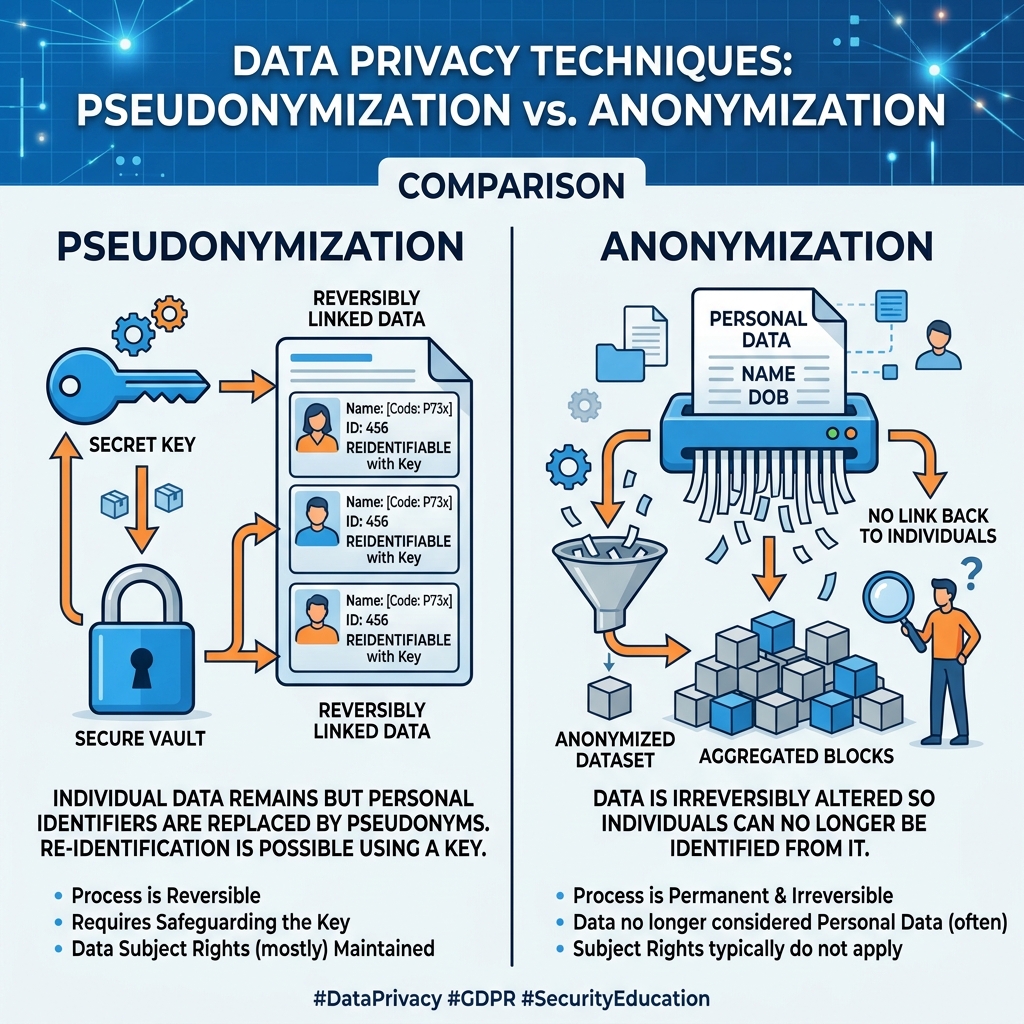
In the field of data protection, the terms **pseudonymization** and **anonymization** are often used interchangeably, but they have distinct technical and legal meanings under the GDPR. Understanding these differences is crucial for anyone handling personal data.
What is Pseudonymization?
Pseudonymization involves replacing private information with artificial identifiers (pseudonyms). While it enhances privacy, the data remains personal because it's still possible to re-identify the individuals with additional information. Consequently, pseudonymized data still falls under the scope of GDPR.
What is Real Anonymization?
Real anonymization, on the other hand, is a process that renders the data irreversible. Once data is truly anonymized, it can no longer be linked to an individual, even with additional information. As a result, truly anonymized data is no longer considered personal data and is outside the scope of GDPR.
Conclusion
While pseudonymization is a valuable security measure, real anonymization is the gold standard for data privacy. Our tool provides real anonymization by processing data locally and ensuring that the original identifiers are never stored or transmitted, keeping your business fully secure and compliant.